
News
Beginning Arduino Robotics with Azhar Muhammed
Gareth Halfacree
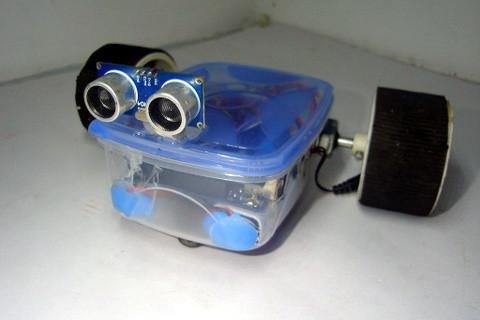
Building a robot is a project well-suited to the Arduino. Building a robot which can be controlled wirelessly via a smartphone is a logical follow-on project. Building an autonomous robot follows, but making the leap between getting a motor to spin on demand and programming your very own 'smart' robot can be a daunting step to take. For anyone interested in getting started with Arduino robotics, maker Azhar Muhammed has published his second Instructable - following his earlier pipe-based robot project - and it's a great way to break into the subject. Despite being made to a low budget and...
Arduino IDE 1.6.10 Release Boasts Smaller Sketch Sizes
Gareth Halfacree
Arduino.cc has launched the latest revision of the Arduino Integrated Development Environment (IDE), version 1.6.10, and there's good news for anyone who uses AVR-based Arduinos and compatibles like the Uno, Nano, and Micro: sketches now take up less flash memory on your device. For AVR-based Arduinos and compatibles, memory is always at a premium. The Arduino Uno, the most popular model, has just 31.5KB of flash storage available - meaning that if your sketch compiles to a binary larger than this, it simply won't install. Other models have even less storage available: the Arduino Leonardo has 28KB free after the...
Mayukh Nath's Educational H-Bridge Circuit Project
Gareth Halfacree
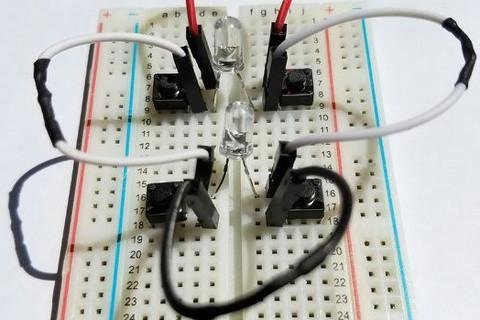
The humble H-bridge is the most common means of controlling DC motors from an Arduino or other microcontroller. Allowing for bidirectional control - unlike a simple relay or transistor, which could only run the motor in a single direction - the H-bridge is handy, but its typical packaging as a black integrated circuit makes it hard to guess what's actually going on under the hood. Curiosity as to how an H-bridge actually works drove maker Mayukh Nath to to investigate its inner workings. Discovering that the circuit hidden beneath the plastic casing is surprisingly simple, Mayukh designed his own as...
Open Source Optimisation with the Arduino Enigma QR Clock
Gareth Halfacree
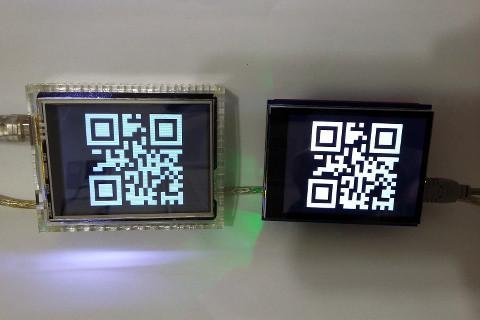
The beauty of releasing code under permissive, open-source licences is that others are free to improve and build upon what you've created. We're always thrilled to see software and hardware we've designed pop up in unusual places, and doubly so if it enhances on our original creation. We're not alone, of course, as exemplified by the Arduino Enigma project. The project on which the Arduino Enigma is based was released back in 2012. Designed as an awkwardly-unreadable clock - the time-telling equivalent of a useless machine, in effect - the original design generated a Quick Response Code (QR Code) for...
Visualising Your PCB Designs with EasyEDA's Gerber Viewer
Gareth Halfacree
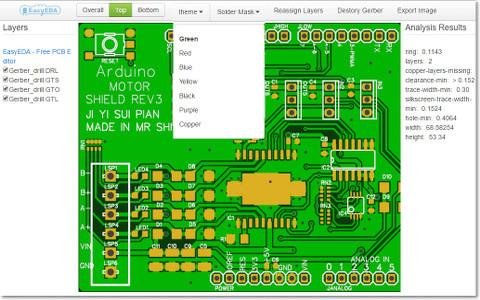
There is no shortage of ways to design your own circuit boards: from the traditional methods with pen, tape and transfers through to modern computer-aided design, it doesn't really matter what your skill level or experience is. Pretty soon, though, you'll come across Gerbers. The go-to standard for digitally-designed printed circuit boards, the Gerber format - RS-274X - contains all the information a manufacturer needs to produce physical circuit boards matching your designs, from each layer's layout to where through-holes and vias should be drilled. Regardless of the software you use to actually perform the design work, it's near-guaranteed that...