
News
Building a Cheap Drill Press Vice Quick-Release Clamp
Gareth Halfacree

If you're lucky enough to own a drill press, or are a member at a hackspace or collaborate maker space with one, the latest project from Instructables member "djpolymath" could save you considerable time: using bicycle seat releases to quickly attach and detach a vice from the drill press table. If you've never used a drill press before, you're excused from knowing that the vice is one of the most important parts: the piece to be drilled must be held securely in place, both to ensure a smooth and accurate drill and to prevent any fingers coming into contact with...
Purifying Water with an Arduino, UV Lamp, and a Bicycle
Gareth Halfacree
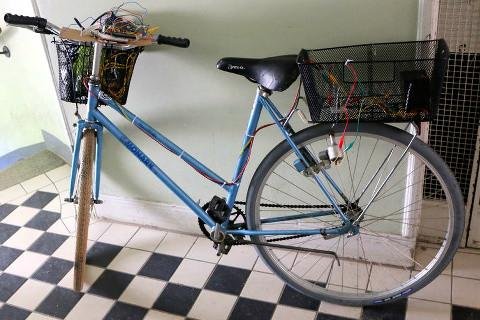
Building a project with an Arduino is one thing, but powering it can be quite another. Batteries work, naturally, but need to be replaced; solar panels are one solution to keeping them topped up, but Danja Mewes has another: bicycle power. In her latest Instructable, Danja explains how to build an Arduino-based water purification system. Using an ultraviolet light to kill any nasties in the water, along with a pump and filter to remove particles you don't want to drink, Danja's system relies on a hefty battery mounted in the rear basket of the bike for its power. The battery,...
Nick Poole's Weatherpoof, Flexible Laminated Circuit Experiments
.:oom lout:.
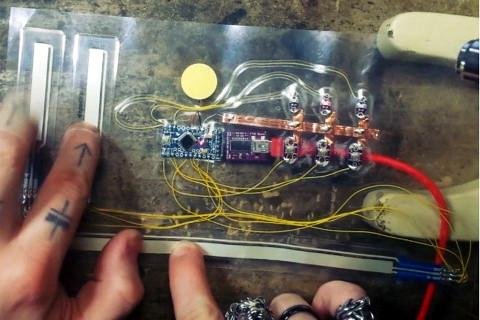
Heat-based laminators, an office staple, are often pressed into service by electronics hobbyists looking to produce printed circuit boards using the toner transfer method. Nick Poole, though, has been using his office laminator for a different purpose: creating self-contained, waterproof circuits on the cheap. Described in full over on the SparkFun blog, Nick's experiments have been taking place over the past few months and are surprisingly detailed. Starting with a membrane-based potentiometer, Nick was able to create a laminated four-key touchpad; emboldened by success, Nick turned to a larger alphanumeric keypad for another project. So far, his experiments had concentrated...
Tanmay Deuskar's Transistor-Based Motor Driver Circuit
Gareth Halfacree
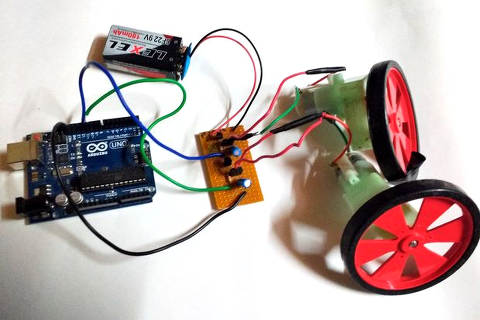
When you want to connect a motor up to an Arduino or other microcontroller, the natural response is to reach for an H-bridge chip. Granted, that's exactly what an H-bridge is for - but it's possible to achieve the same result using a simple custom circuit based around low-cost NPN transistors, as demonstrated by Tanmay Deuskar in his latest Instructable. Based on the readly-available and low-cost BC-547 NPN transistor, a pair of 1K Ohm resistors, two capacitors, and incidental components including headers and a 9V battery, Tanmay's circuit is simple and affordable. While it isn't as feature-packed as an H-bridge...
Luke Szynalski's RFID-Based PC Login Project
Gareth Halfacree
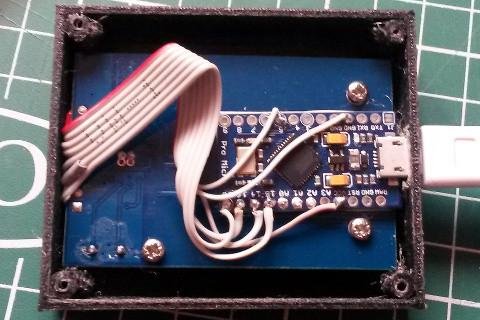
Radio-frequency identification (RFID) tags are commonly used to power contactless keycard entry systems, but Luke Szynalski had a different plan in mind: an Arduino-powered RFID login system for his desktop computer, making it easier to log in without harming security. RFID tags are surprisingly powerful devices thanks to their use of parasitic power: unlike radio fobs used to, for example, unlock a car and disarm the alarm, an RFID tag requires no power source of its own. Instead, when the RFID tag comes within range of a transmitter, it harvests the power and responds with a 'ping' of its own...